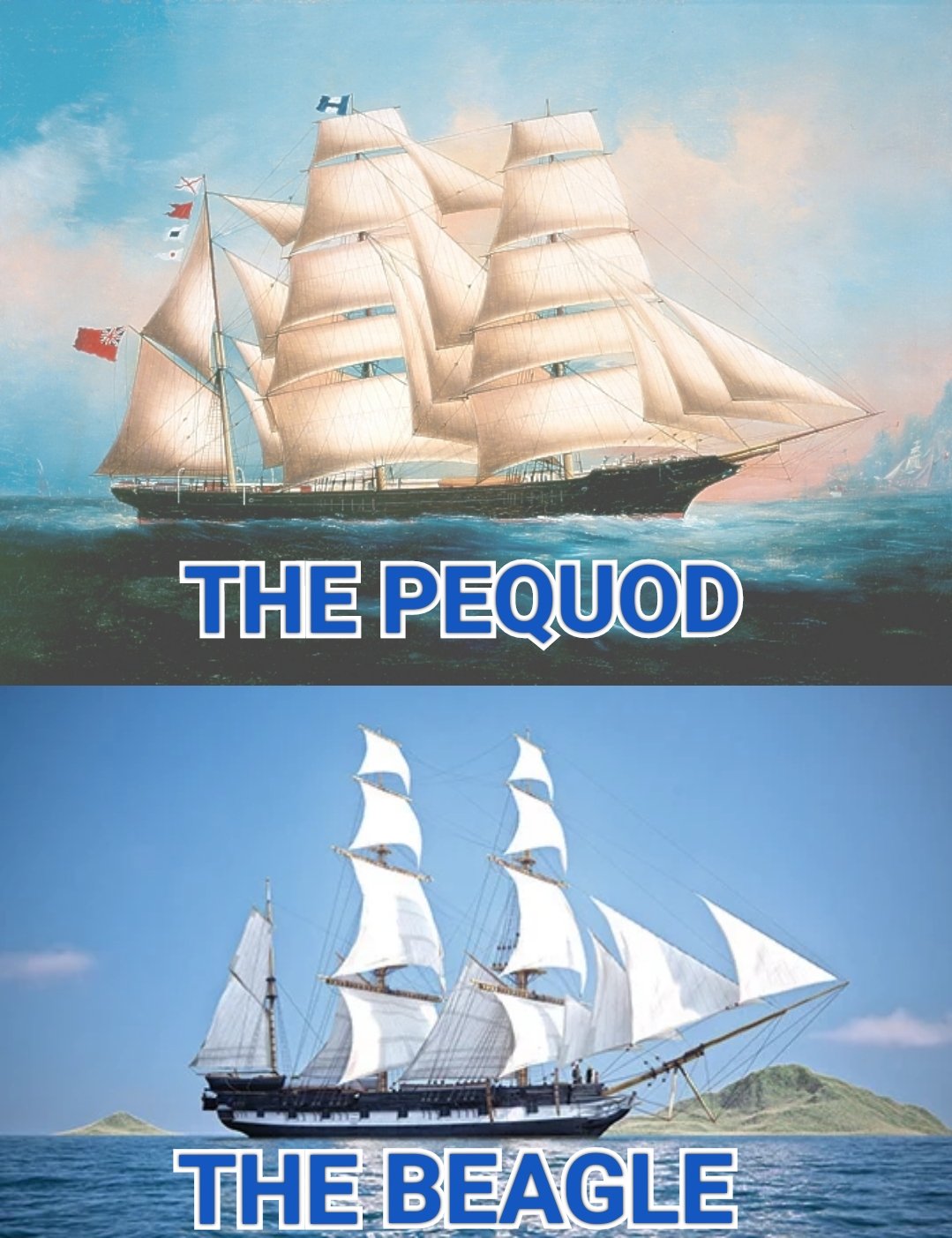
There’s more than just a maritime connection between these two enigmatic contemporaries, one fictitious and one real. Captain Ahab sailed the Pequod, hunting an elusive white whale; while Darwin sailed the Beagle hunting elusive anatomical homologies in search of a theory that could explain the march of life on earth. But I wonder if anyone has noticed parallels between these two before this. Both characters had their heyday in the same decade (1850s) when both Moby Dick and the Origin of Species were published. However, my fascination is with the sharp extremes of their respective sense-making apparatus. I was always drawn to the mystique and tint of autistic clairvoyance in the aphasic Ahab’s famous line: “Ahab never thinks, he only feels, feels, feels”, the repetition of the strophe having a mesmerizing, chant-like character. Darwin on the other hand, equally rhetorically expressed his brutal obsession with “facts, facts, facts”, as he catalogued masses of anatomical variation through his Pacific odyssey. The extremes of the two approaches seem amplified to me by the lilting “l” of “feels” and the chipped edge of “facts” – one conveying the fluid leaps of our right brain, and the other the measured tread of the left brain. They serve as picturesque metaphors for skewed perceptual systems.
Another metaphorical pairing that occurred to me some time ago was that of Ptolemy and Copernicus. It came to me as I thought about that chronic corporate see-saw malaise about centralization versus decentralization. Ptolemy, of course, put the earth at the center of the solar system, while Copernicus ascribed to it its rightful place in an important but unassuming little orbit along with eight other planets. I have known CEO’s and leaders who have a Ptolemaic psyche, putting the corporate or regional HQ at the center of their universe, while others who are more sagely Copernican – getting the balance right in the integrality versus modularity spectrum. The best insight I came across in this perennial dilemma was captured in the words: “if you organize one way, you should manage the other.” If you’re structurally centralized, you should be culturally decentralized, and vice versa – this is the only way of getting the force fields to find equilibrium, or else an oscillation between the two becomes inevitable.
Other pairs which intrigue me, and provide rich metaphorical content across different frames: 1. the Dialog approach of Socrates versus the Academy approach of Plato – both symbolize pedagogical content-design models which should be skillfully combined in any worthwhile mindset-shaping leadership program. 2. Javert and Jean Valjean (from Les Miserables) symbolizing an endless pursuit of a Sisyphean character – a more slapstick version of the same motif being Wile E Coyote and the Road Runner.
 Notes to Self
Leave a comment